Discover how you would organize your week if money were no object. Practical tips to better align your daily life with what you really need for happiness.
 Rogier Rijnja
If money wasn't a factor, how would you organize your week?
Just to be clear, this isn't the same question as: "If you had all the money in the world, what would your life look like?". This isn't a call to imagine a dream life that feels unattainable anyway, but rather to realistically see more clearly what you actually need in your daily life.
Many people don't get stuck because they're necessarily doing the wrong job, but because their week structurally doesn't fit what they need. They have too little rest, too little autonomy, too little time to really dive into something or conversely too little contact and variety. By thinking not in terms of jobs, but in terms of time, it becomes much clearer where the friction is. That's why we've created a simple exercise for you that helps you get that clarity. Not vaguely, but step by step.
This is why this exercise works
This question doesn't just show what you enjoy, but especially how you would want to spend your time when income, expectations and obligations are temporarily out of the picture. This reveals what you might be missing right now. Maybe you'll discover that you don't want to do less, but you do want to feel less restless. Maybe you don't necessarily want different work, but you do want more space for sports, reading, cooking or just not having to do anything. And maybe you'll see that your ideal week says more about your career choices than you thought. That's why this exercise works best when you actually write it out.
Step 1: write down what your week actually looks like right now
Don't start with your ideal week, but with your real week. Grab your calendar, a notebook or a blank document and write down where your time goes in an average week right now. Think about work, travel time, household tasks, scrolling, exercising, social plans, cooking, resting and all the little things that quietly consume time. Be honest. It's precisely by making your week concrete that you often see where your time really goes.
Step 2: make your current week visible
Put that real week into an overview afterward. You can do this in hours or in parts of the day. It doesn't have to be perfect, as long as it makes clear how your time is currently divided. Also include things like switching between tasks, waiting, scrolling, or recovering from fatigue. These are often the parts you normally don't count, but that do take up a lot of space.
Step 3: See where your week chafes
Then look at your overview and ask yourself a few simple questions. Where does a lot of time go without it really giving you anything in return? Where do you mainly feel pressure or restlessness? Where is there remarkably little room for things that give you energy? Maybe you'll notice that your week is mainly filled with "have to's." Maybe you see that you do have free time, but not in a way that recharges you. Or that your days are so fragmented that you never really get into anything.
Step 4: Write down what you would like to spend time on
Only then do you move on to your ideal week. Write down everything you would like to give attention to in a week if money played no role. Make it concrete. Think about working on something you enjoy, walking, sports, football, dancing, cooking, sleeping in, reading, time with friends, time with your partner, making music, learning something new, resting, visiting family, or just time outside. Try not to limit yourself yet. In this step, you're just collecting.
Step 5: group what belongs together
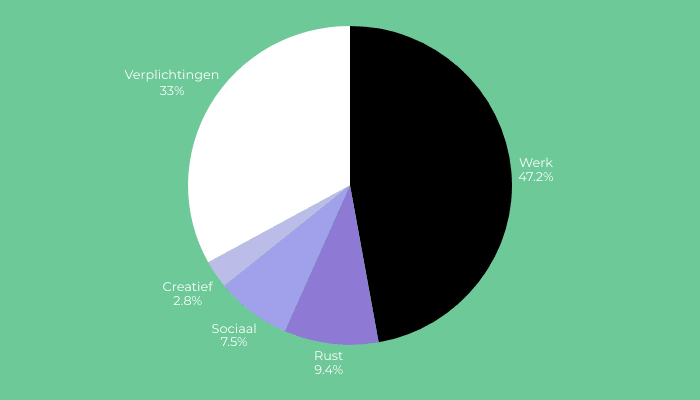
Next, put activities that are similar together. This way you get an overview. You can think of categories like work and meaningful activities, rest and recovery, social time, exercise, creative time, relaxation and practical tasks. There's no perfect categorization. The goal is for you to see what types of time are important to you.
Step 6: make your ideal week concrete
Now divide up a week as you would ideally like to live it. That can be in hours, but also in parts of the day. Don't think about vacation, but about a regular week that feels good and suits you. Maybe you want to work less, or actually work the same amount but with more rest around it. Maybe you want to exercise every day, more uninterrupted time to read or create, or more empty space in your schedule. Anything goes, as long as it's honest.
Step 7: also write down how that week should feel
This step is important. Don't just write down what you want to do, but also how you want your week to feel. Do you want to live more calmly? More variety? Be less rushed? More focus? More freedom? More time alone or actually more contact? Two weeks can look the same on paper, but feel very different. It's precisely that feeling that tells you a lot about what you need.
Step 8: compare your real week with your ideal week
Place the two weeks side by side. Look at where the biggest differences lie. Are you mainly missing rest, movement, creativity, time with others, or time for yourself? Or is the problem more in how your week is currently structured? Maybe you'll discover that you don't need different work, but less restlessness. Or that your free time is there, but not in a form that truly helps you recover. Perhaps you'll see that your ideal week isn't radically different at all, just better distributed.
Step 9: choose three things you miss most right now
Don't try to change everything at once. Choose three parts from your ideal week that you miss most right now. These can be big things, like more meaningful work or more time for yourself. But smaller things count too, like cooking peacefully, reading, or an evening without plans. It's precisely by choosing that you make the exercise useful.
Step 10: think about what you can adjust right away
Ask yourself for each element: what can I already bring back a little bit of this into my week? If you're missing more rest, you could perhaps keep one evening free. If you're missing movement, you could plan two fixed walking moments. If you're missing creativity, you could block one hour per week to write, cook, draw or make music again. Small changes might seem modest, but they often give the clearest signal most quickly.
Step 11: Create a feasible better week
Your ideal week doesn't have to be immediately achievable. So create a third version: a realistically better week. One that's not perfect, but fits you better. Ask yourself what you can shift, eliminate, or protect within your current life. This makes the exercise practical and prevents it from staying just a thought experiment.
What this exercise gives you
By first writing out your real week and then your ideal week, you quickly gain insight into where your time currently goes and what you're missing. This helps not only with personal choices, but also with decisions about work and your future. At FindMino we believe that a suitable career isn't just about what you do, but also about how you want to live your days. Because ultimately, your life consists of weeks like this.
About the author Rogier Rijnja
Rogier is co-founder van Findmino. Hij heeft veel internationale ervaring in senior management rollen in bedrijven als Nike, Apple, Amazon, Danone en een paar Nederlandse merken. Naast business is hij geïnteresseerd in wat Nederland nou zo mooi maakt.
Useful websites
Your website here
Visit website
Disclaimer
The information on this page is meant as general inspiration. We share links to third-party websites that may interest you, but we cannot guarantee that the content is always up-to-date, accurate or safe.
Comments (0)
Log in to comment