Why Burn-out Hits Young Professionals So Hard, and What You Can Do About It
You're ambitious, want to prove yourself and say yes to everything. You keep working longer hours, take on extra projects and ignore your fatigue — because "that's how you build a career," right?
But it's precisely that drive that makes young professionals extra vulnerable to burn-out.
As an HR professional with years of experience across diverse sectors and countries, I've seen countless young talents burn out before their careers even properly took off. The cause is rarely unwillingness or weakness — often it's actually too much ambition.
What Burn-out Really Is
Burn-out isn't ordinary tiredness. The World Health Organization describes it as a syndrome caused by prolonged workplace stress that isn't properly managed. It has three clear characteristics:
- Emotional exhaustion – Your battery is empty, no matter how well you sleep.
- Cynicism or depersonalization – You become distant or negative about your work and colleagues.
- Reduced effectiveness – You start doubting your own abilities.
For young professionals, this process often creeps in slowly. The signs seem like normal stress or 'beginner problems' — and that's why they're often ignored.
Why Young Professionals Are Extra Vulnerable
Pressure to prove yourself
You want to show what you're worth and take on everything that comes your way.
Unclear boundaries
As a starter, you don't yet know what's 'normal' or achievable.
Imposter syndrome
Self-doubt can lead to overcompensating and overworking.
Financial pressure
Student debt, rent and the desire to be independent make it difficult to say "no."
Social comparison
LinkedIn and office stories can paint an unrealistic picture of success.
The Early Warning Signs
Burn-out rarely starts suddenly. The first signs are subtle:
Physical: persistent fatigue, headaches, tense muscles, poor sleep, getting sick more often.
Emotional: quick irritation, loss of motivation, anxiety, feeling empty or distant.
Behavioral: procrastination, more mistakes, withdrawing, canceling more often, substance use to relax.
Cognitive: concentration problems, negative self-talk, feeling that nothing matters.
Recognizing these signs is crucial. The earlier you intervene, the better you can recover — or prevent worse.
Effective Strategies to Prevent Burn-out
Set realistic expectations
Your career isn't a sprint. You don't have to be able to do everything at once. Being good at your current role is already valuable.
Learn to say "no" strategically
Not every extra project helps you advance. Protecting your boundaries is professional behavior, not weakness.
Draw clear boundaries
For example: no work emails after 9 PM, one day per weekend truly free, lunch not at your desk.
Build a support network
Find a mentor, talk with industry peers, maintain friendships outside of work.
Invest in stress management
Exercise, rest, hobbies, mindfulness or journaling — whatever works for you.
Watch your energy, not just your time
Schedule important work for when you're most sharp.
Be gentle with yourself
You're allowed to make mistakes and grow. Self-compassion isn't a luxury, but a necessity.
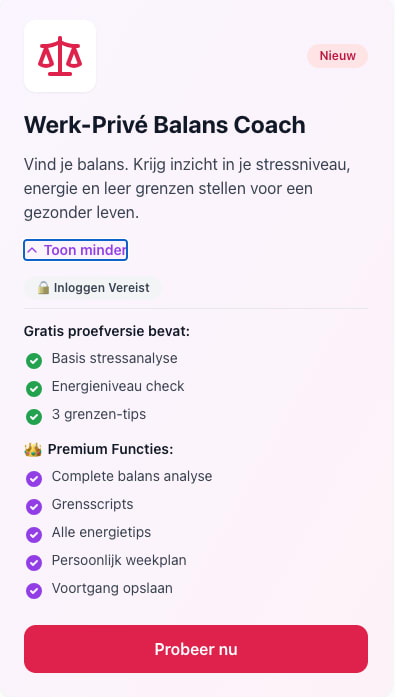
Check our effective Life & Career tools, like this one.
If You're Already In Burn-out
👉 Short term (this week): take rest (even if it's just a long weekend), talk to someone you trust, delegate or postpone something, ensure sleep and basic self-care.
👉 Within a month: have an honest conversation with your supervisor, review your priorities, cut non-essential tasks, pick up healthy routines again.
👉 Long term: develop sustainable work habits, build a stronger network, and realign your career based on your values and energy.
When Professional Help Is Important
Doubting your mental health? Don't wait too long. Seek help if you notice that feelings of exhaustion, hopelessness or anxiety persist, or if you notice that your health and relationships are suffering. Many employers offer confidential support through Employee Assistance Programs (EAP) — make use of it.
In Conclusion
The goal isn't to avoid all stress. A little stress can challenge you and help you grow.
The goal is to build a career that gives energy instead of depleting it.
✅ Your value isn't determined by how many hours you work.
✅ Taking care of yourself is essential for sustainable performance.
✅ Successful professionals learn to combine their ambition with well-being.
If you recognize the signs of burn-out: that's not weakness, but a first step toward recovery. Be gentle with yourself, seek support and dare to choose a career that isn't just successful — but also sustainable.